Lithops karasmontana Care Guide
Learn how to grow Lithops karasmontana with bright light, mineral soil, seasonal watering, and careful dry rest during leaf renewal and winter.
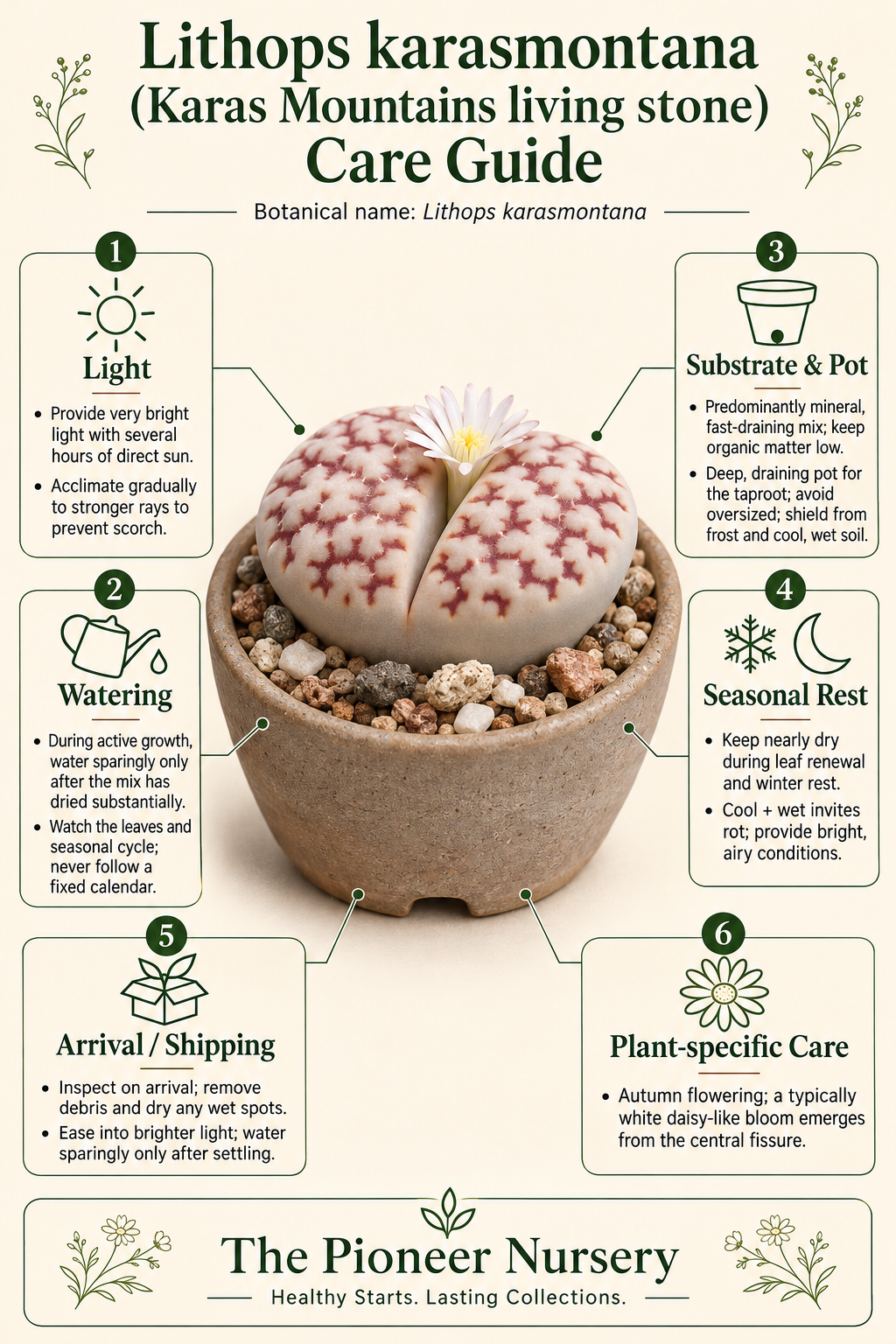
Lithops karasmontana is a compact, taprooted living stone from arid southern Africa. Its care depends on bright light, very fast drainage, and careful seasonal watering rather than constant moisture. The most important cycle to observe is leaf renewal: the old leaves should gradually dry as the new pair develops, and watering during this process can cause splitting or rot.
Quick Care Summary
- Provide very bright light with several hours of direct sun, acclimated gradually.
- Use a predominantly mineral, fast-draining substrate.
- Water sparingly during active growth only after the mix has dried substantially.
- Keep the plant nearly dry during leaf renewal and winter rest.
- Use a deep container with drainage to accommodate the taproot, but avoid oversized pots.
- Protect from frost and from cool, wet soil.
- Watch the leaves and seasonal cycle instead of following a fixed watering calendar.
About Lithops karasmontana
This species is a compact succulent mimic commonly called a Karas Mountains living stone. It grows as a paired, stone-like body with a fissure between the leaves and a taproot below. Mature plants generally flower from the fissure in autumn, producing typically white flowers about 3–4 cm across. The species can vary in appearance, and no subspecific or locality designation should be assumed without reliable provenance.
Light
Provide very bright light with several hours of direct sun. Acclimate gradually after shipping or after moving the plant to stronger light, since sudden intense exposure can cause sunscald. In hot indoor or greenhouse conditions, light afternoon filtering and good ventilation can help reduce overheating. Insufficient light may cause stretching and weak coloration.
Watering
Use the plant’s seasonal cycle rather than a fixed calendar. During active growth, water thoroughly but sparingly only after the substrate has dried substantially. Reduce or stop watering while the new leaves develop and absorb the old pair; moisture at this stage can interrupt the renewal cycle and increase the risk of splitting or rot. After flowering and through winter rest, keep the plant nearly dry, watering only when prolonged shriveling indicates a genuine need.
Soil and substrate
Use a predominantly mineral cactus or succulent mix with excellent aeration and minimal moisture retention. Pumice, coarse sand, grit, or similar mineral components are appropriate. Avoid rich organic soil and any mix that stays wet around the roots for extended periods.
Potting and roots
Lithops karasmontana has a taproot, so established plants commonly benefit from a pot about 8–15 cm deep with drainage holes. Choose a container only slightly larger than the root system; oversized pots stay wet longer. Keep the body high enough that the upper plant and leaf fissure remain exposed, and add a mineral top dressing if desired. Repot only when necessary and handle the roots carefully.
Temperature and ventilation
Protect the plant from frost and prolonged cold, wet conditions. Low temperatures are better tolerated when the substrate is very dry. Warm, bright, well-ventilated conditions are safest during active growth, while cool conditions should be paired with minimal moisture.
Seasonal growth and dormancy
Lithops follow a pronounced annual leaf-replacement cycle. The old leaves normally shrivel as the new pair develops, followed by a relatively dry period. The exact timing varies with latitude, temperature, light, and growing conditions, so observe the leaves and substrate rather than following a calendar alone. Winter and leaf renewal generally require much less water than active growth.
Fertilizer
Feed lightly only during active growth, using a diluted balanced fertilizer at intervals suited to the plant’s growth and environment. Do not fertilize a dry, dormant, recently repotted, or stressed plant. Excess feeding can produce soft, unnatural growth.
Flowering
Mature plants generally flower in autumn. Flowers emerge from the central fissure and are typically white, often approximately 3–4 cm across. Strong light and a properly observed seasonal cycle support flowering.
Propagation
Seed is the primary propagation method. Sow in a free-draining mineral medium under warm, bright conditions. Established clumps may also be divided or offsets separated when naturally available, but unnecessary division and root disturbance should be avoided.
Common problems
Root or stem-base rot usually follows frequent watering, poor drainage, or cool wet conditions. Leaf splitting or bursting can result from excessive or poorly timed watering. Continued watering during leaf renewal may prevent the old leaves from drying down properly. Stretching and weak coloration indicate inadequate light, while sudden intense sun can cause sunscald. Mealybugs and aphids are reported pests. Overpotting and organic, water-retentive soil also prolong wetness around the roots.
Shipping and arrival care
After bare-root or dry shipping, inspect the plant for damage, rot, and desiccation. Pot it into completely dry, well-drained substrate, and allow damaged roots or wounds to dry before cautious watering. Reintroduce strong light gradually. Do not water immediately after major root disturbance, and avoid combining cold temperatures with wet soil during transit or recovery.
Frequently Asked Questions
How often should I water Lithops karasmontana?
Do not use a fixed schedule. During active growth, water thoroughly but sparingly after the substrate has dried substantially. Reduce or stop watering during leaf renewal, then keep the plant nearly dry after flowering and through winter.
Why is my Lithops karasmontana splitting?
Splitting can follow excessive or poorly timed watering, especially during the annual leaf-renewal period. Allow the substrate to dry substantially and avoid watering while the new leaves are absorbing the old pair.
Does Lithops karasmontana need direct sun?
It needs very bright light with several hours of direct sun. Acclimate gradually after shipping or a move, because sudden intense light can cause sunscald.
What type of pot does it need?
Use a drainage pot with enough depth for its taproot; established plants commonly use about 8–15 cm of depth. Avoid oversized pots that remain wet for long periods.
When does Lithops karasmontana flower?
Mature plants generally flower in autumn. The flowers emerge from the fissure and are typically white, often about 3–4 cm across.
Can I water immediately after receiving a shipped plant?
Not necessarily. Inspect it first, pot it into completely dry mineral substrate, and allow damaged roots or wounds to dry before cautious watering. The appropriate recovery approach depends on its condition and the extent of root disturbance.
Lithops karasmontana rewards observation more than routine. Give it strong light, mineral drainage, and enough seasonal dryness for the old leaves to complete their renewal cycle. A dry root zone during cool conditions is especially important for keeping this living stone healthy.