Euphorbia francoisii Care Guide
Learn how to grow Euphorbia francoisii, a slow-growing Madagascan caudiciform with a tuberous root, variable foliage, and a strong need for warmth, bright light, and fast drainage.
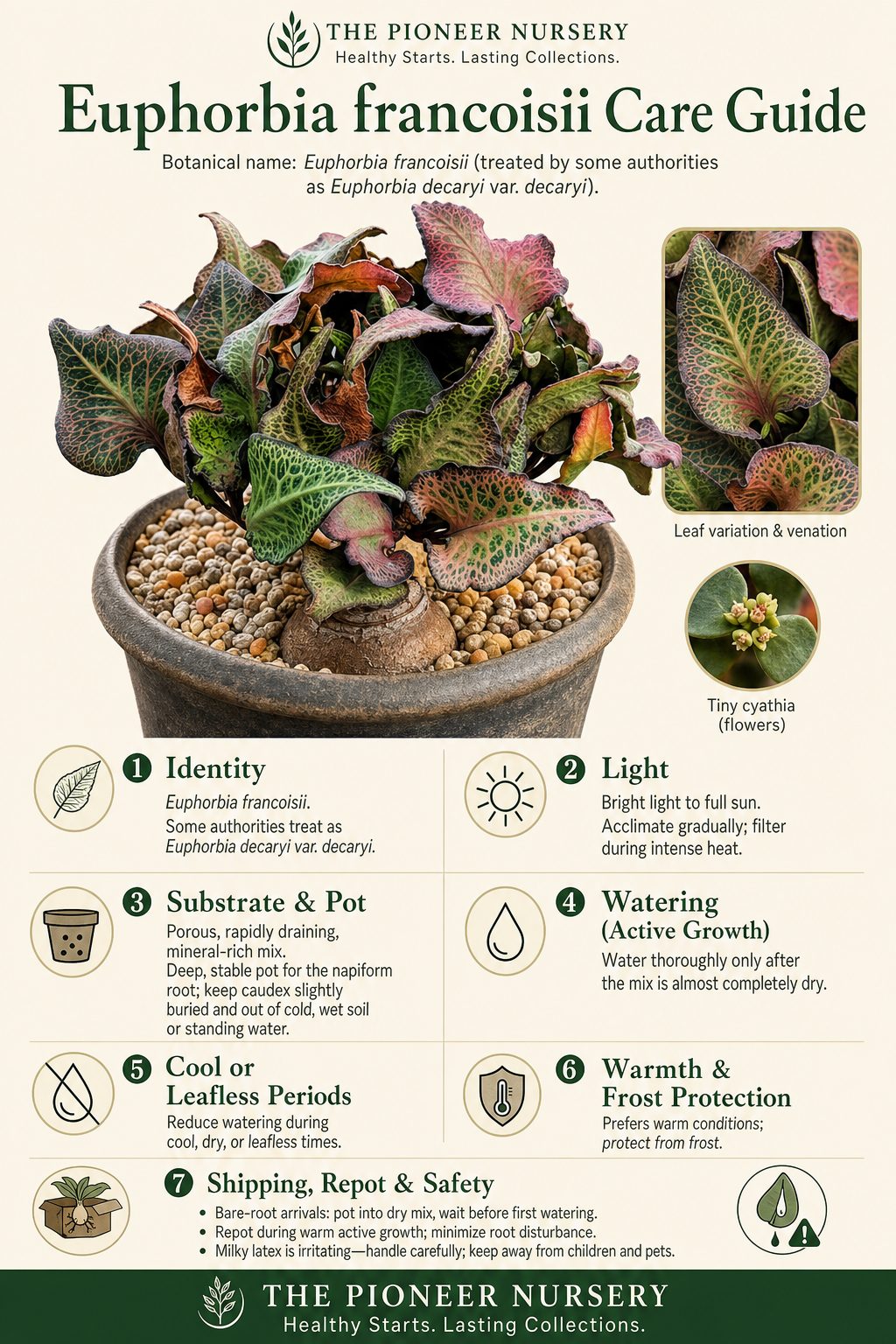
Euphorbia francoisii, also known as Francois' euphorbia, is a slow-growing Madagascan caudiciform Euphorbia with a napiform, tuberous root and highly variable leaves. It is not a conventional desert cactus: the most important care priorities are bright light with gradual acclimation, a porous mineral-rich substrate, careful watering, and protection from cold, wet conditions. Plants sold under this name may include selected horticultural forms or hybrids, so leaf shape, coloration, variegation, and flowers can vary considerably.
Quick Care Summary
- Bright light to full sun, with gradual acclimation and filtered protection during intense heat.
- Use a porous, rapidly draining, mineral-rich substrate.
- Water thoroughly only after the substrate has dried almost completely during active growth.
- Reduce watering during cool, dry, or leafless periods.
- Protect the tuberous root and caudex from cold, wet soil and standing water.
- Use a stable pot with enough depth for the napiform root.
- Repot during warm active growth and minimize root disturbance.
- Handle the irritating milky latex carefully and keep the plant away from children and pets.
About the plant and its name
Euphorbia francoisii is a legitimate published botanical name that remains widely used in specialist horticulture. Plants of the World Online currently treats it as a synonym of Euphorbia decaryi var. decaryi, while other authorities and specialist references retain E. francoisii at species rank. This guide preserves Euphorbia francoisii as the primary nursery identity while noting that the taxonomic treatment is not uniform. Cultivated plants may also represent selected forms or hybrids, including reported crosses with Euphorbia tulearensis, so unusual foliage or flowers should not automatically be assigned a formal botanical variety.
Light
Provide bright light to full sun. During very intense heat, light shade or filtered protection can help. Acclimate gradually after shipping or when moving a plant from shaded nursery conditions into stronger sun; abrupt exposure can cause leaf scorch or sudden color changes. Strong light generally supports compact growth and better leaf coloration.
Watering
During active growth, water thoroughly only after the substrate has dried almost completely, then allow it to dry again. Reduce watering during cool, dry, or leafless periods. Yellowing or leaf drop during a cooler period is a cue to reduce watering rather than keeping the plant constantly wet. Avoid standing water, especially because the tuberous root and underground stem are vulnerable to rot in cold, damp conditions.
Soil and substrate
Use a very porous, rapidly draining, mineral-rich succulent substrate with substantial aeration. Pumice, perlite, coarse grit, or similar mineral components can form the main structure, with only a modest organic fraction. The finished medium should not remain wet for extended periods.
Potting and the tuberous root
Choose a stable container with excellent drainage and enough depth for the napiform or tuberous root; unnecessarily shallow pots are not suitable. Repot during warm active growth when possible and disturb the specialized root system as little as practical. If major root damage occurs, delay heavy watering until damaged roots have dried and callused and the plant shows recovery. Although the caudex can eventually be raised for display, exposing it too early may limit further enlargement, so delayed exposure is preferable.
Temperature and seasonal growth
Warm conditions are preferred. Specialist guidance places a practical winter minimum for many Madagascan succulent Euphorbias around 10–15 °C (50–59 °F), while the Henry Shaw Cactus and Succulent Society gives approximately 60–90 °F as a cultivation range. Protect the plant from frost and from cold combined with wet soil. A pronounced obligatory dormancy is not consistently reported, but growth may pause and leaves may yellow or drop during cooler, drier periods.
Fertilizer
Species-specific fertilizer trials were not located. During active growth, use a dilute, balanced fertilizer sparingly and only when the plant is well hydrated and actively producing leaves. Avoid heavy feeding during cool, dry, or leafless periods.
Flowering
Small Euphorbia cyathia may appear from late spring into early summer under favorable warm, bright conditions. Cultivated selections and hybrids can show flower colors and forms different from those typically described for wild plants, so flowering may vary among nursery specimens.
Propagation
Propagation is reported from seed and stem cuttings. Seed-raised plants tend to develop a more rounded, solitary or sparsely branched caudex, while cutting-grown plants commonly form thinner, more branched, and tangled roots. For cuttings, allow the cut surface to dry and callus before placing it into a dry, porous medium. Resume watering cautiously after rooting begins.
Shipping and arrival care
Inspect the plant after arrival and protect it from freezing temperatures, prolonged moisture, and crushing of the caudex or tuberous root. If it arrives bare-root, handle the root system gently and allow any wounds to dry before potting. Begin with bright indirect or gentle filtered light, then acclimate gradually to stronger light. Do not water immediately after shipping if roots were damaged or remain uncallused; recovery depends on the plant's condition rather than a fixed schedule.
Safety and trade considerations
Euphorbia produces irritating milky latex. Avoid skin and eye contact, and keep the plant away from children and pets. Because this Madagascan taxon is associated with conservation and international trade controls, current CITES and import requirements should be verified before international shipment.
Common Problems
- Root or caudex rot: commonly associated with cold, wet soil or poor drainage.
- Leaf scorch or abrupt color change: often follows sudden exposure to strong sun; acclimate gradually.
- Delayed recovery: may follow rough repotting or bare-root shipping, especially when roots are damaged.
- Mealybugs and other common succulent pests: monitor dense foliage and stressed plants.
- Fungal problems: cool, stagnant, humid conditions can favor them.
- Milky latex irritation: avoid contact with skin and eyes.
Frequently Asked Questions
How often should Euphorbia francoisii be watered?
Do not use a fixed calendar. During active growth, water thoroughly after the substrate has dried almost completely, then let it dry again. Water less during cool, dry, or leafless periods.
Can Euphorbia francoisii grow in full sun?
Yes, bright light to full sun is appropriate, but acclimate gradually after shipping or a move from shade. Filtered protection may help during very intense heat.
Why is my plant losing leaves?
Growth may pause and leaves may yellow or drop during cooler, drier periods. Treat this as a cue to reduce watering, and avoid keeping the plant wet.
Should the caudex be raised above the soil?
The caudex can be raised for display, but exposing it too early may limit further enlargement. Delayed exposure is preferable.
Can Euphorbia francoisii be propagated from cuttings?
Propagation is reported from seed and stem cuttings. Allow cut surfaces to dry and callus before placing cuttings in a dry, porous medium, then water cautiously once rooting begins.
Is Euphorbia francoisii the same as Euphorbia decaryi var. decaryi?
Plants of the World Online treats Euphorbia francoisii as a synonym of Euphorbia decaryi var. decaryi, while other authorities and specialist horticulture continue to use E. francoisii at species rank. The names reflect differing taxonomic treatments.
With warmth, strong but carefully acclimated light, fast drainage, and restrained watering during cool or leafless periods, Euphorbia francoisii can develop into a distinctive caudiciform specimen. Monitor the tuberous root closely, especially whenever temperatures are low or the substrate stays wet.