Dorstenia foetida Care Guide
Learn how to grow Dorstenia foetida, a warm-growing succulent subshrub with a thickened basal stem, unusual disk-like flowers, and explosive seed dispersal.
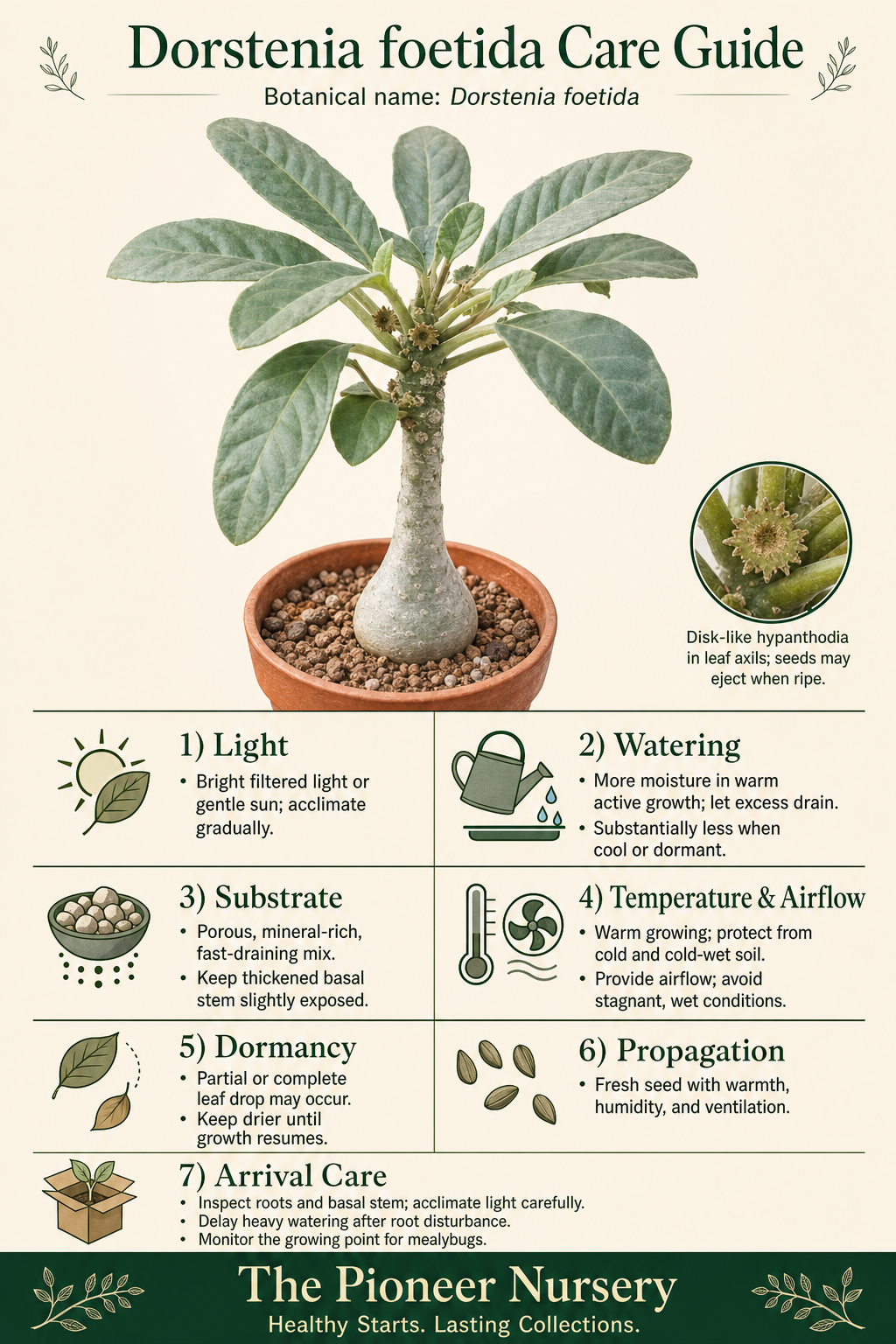
Dorstenia foetida, also called foetid Dorstenia or grendelion, is a succulent subshrub in the Moraceae family. Its thickened basal stem, variable foliage, and conspicuous disk-like hypanthodia are characteristic features. Unlike many highly drought-adapted succulents, it appreciates regular moisture during warm active growth, but must be kept considerably drier when cool or dormant. Bright filtered light, excellent drainage, warmth, and careful seasonal watering are the main priorities.
Quick Care Summary
- Bright indirect light or gentle direct sun, with gradual acclimation.
- Water more regularly during warm active growth, while allowing drainage.
- Reduce watering substantially during cool or leafless dormancy.
- Use a porous, mineral-rich, fast-draining substrate.
- Keep the thickened basal stem appropriately exposed rather than deeply buried.
- Protect from frost, near-freezing temperatures, and cold wet soil.
- Provide airflow and monitor the growing point for mealybugs.
About Dorstenia foetida
Dorstenia foetida is native to northeastern tropical Africa and the Arabian Peninsula. In cultivation it develops a succulent, often thickened basal stem and may show considerable variation in leaf size, compactness, coloration, and apparent form. Plants sold under this name can include variable cultivated forms or possible hybrids, but Dorstenia foetida itself is an accepted botanical species name.
Light
Provide bright indirect light or gentle direct sun. Acclimate the plant gradually before exposing it to stronger sunlight, since unacclimated foliage can scorch. Insufficient light may cause elongated growth with larger, more widely spaced leaves. After shipping, begin with bright but filtered light and increase direct sun gradually.
Watering
Water regularly during warm active growth, allowing excess water to drain freely between waterings. Dorstenia foetida generally tolerates and appreciates more moisture in active growth than many arid succulents, but it should not remain in continuously saturated soil. Reduce watering substantially in cooler conditions or during leaf-drop dormancy. Cold temperatures combined with wet soil create a serious rot risk.
Soil and substrate
Use a porous, fast-draining succulent mix with varied particle sizes and strong aeration. A mineral-rich substrate is appropriate; approximately 60% inorganic material and 40% organic material is a useful starting point, although the plant can tolerate a broader range of well-drained soils. Avoid compacted or water-retentive mixes.
Potting and roots
Choose a container with reliable drainage and avoid burying the swollen basal stem deeply. Keep the swollen basal portion appropriately exposed. Repot during active growth when possible. After repotting or significant root disturbance, allow damaged roots time to dry and begin healing before returning to heavy irrigation.
Temperature and airflow
Dorstenia foetida prefers warm conditions and must be protected from frost and near-freezing temperatures. Extended temperatures above approximately 90°F (32°C) may also reduce performance and increase stress, especially when ventilation is poor. Provide good airflow and avoid stagnant, humid conditions around wet foliage and soil.
Seasonal growth and dormancy
Dormancy is variable and may be triggered by cooler temperatures, shorter days, or reduced light. The plant may become partly or completely leafless in winter. Keep it drier while dormant, particularly when temperatures are low. A warm plant receiving adequate light may continue limited growth and require occasional moisture. Leaf loss can be seasonal, but sudden loss from the growing point warrants inspection for pests.
Fertilizer
Feed conservatively only during active growth. A balanced fertilizer diluted well below label strength may be used at intervals suited to the growing environment. Do not fertilize dormant, leafless, cold-stressed, or recently root-disturbed plants. No species-specific fertilizer protocol was identified.
Flowers and seed dispersal
Dorstenia foetida produces conspicuous, disk-like hypanthodia in the leaf axils and may flower repeatedly, often through much of the growing year under cultivation. Mature reproductive structures can eject seeds forcefully, so seedlings may appear in nearby pots. Collect seed promptly if you want to control volunteer seedlings.
Propagation from seed
Fresh seed is the best-supported propagation method in the supplied research. Sow seeds on or very near the surface of a porous medium. Maintain warmth, humidity, and even but non-soggy moisture during germination. Enclosed trays or humidity-retaining containers can help, provided they receive ventilation to limit fungal problems. Collect seed promptly because mature structures disperse it explosively.
Shipping and arrival care
Inspect the plant after arrival, including the basal stem and roots, for damage or rot. Place it in bright but initially filtered light and acclimate gradually to stronger sun. Protect it from cold exposure and prolonged wet conditions. If it arrived bare-root or with substantial root disturbance, delay heavy watering until damaged roots have had time to dry and begin healing; the appropriate recovery approach depends on the plant's condition.
Common problems
Caudex or root rot is associated with cold, saturated conditions or inadequate drainage. Sunburn can follow abrupt exposure to strong direct light. Stretched growth indicates insufficient light. Check the growing point for mealybugs, and monitor for spider mites in hot, dry, or poorly balanced greenhouse conditions. Scale may be difficult to see on older stems with pale or flaking epidermis. Explosive seed dispersal can also produce unwanted volunteer seedlings.
Frequently Asked Questions
Does Dorstenia foetida need to stay completely dry like a cactus?
No. During warm active growth it generally appreciates more regular moisture than many arid succulents. Allow drainage and avoid continuously saturated soil, then reduce watering substantially when conditions are cool or the plant is dormant.
Why is my Dorstenia foetida losing its leaves?
Partial or complete leaf loss can be a seasonal dormancy response triggered by cooler temperatures, shorter days, or reduced light. If leaf loss is sudden and centered around the growing point, inspect the plant for mealybugs or other pests.
Can Dorstenia foetida grow in direct sun?
It can receive gentle direct sun, but acclimate gradually. Abrupt exposure to stronger sunlight can scorch unacclimated foliage.
How should I propagate this species?
Fresh seed is well supported by the supplied cultivation information. Sow it on or near the surface of a porous medium and maintain warmth, humidity, and even but non-soggy moisture with ventilation.
Why are seedlings appearing in nearby pots?
The mature disk-like reproductive structures can eject seeds forcefully. Collect seed promptly if you want to limit volunteer seedlings.
Dorstenia foetida rewards growers who adjust care to its growth cycle. Give it bright, gradually acclimated light, an airy substrate, regular moisture while warm and actively growing, and a much drier routine during cool or leafless periods. With careful attention to temperature, drainage, and airflow, this unusual succulent subshrub can remain a rewarding plant to grow.