Pseudolithos mccoyi Care Guide
Learn how to grow Pseudolithos mccoyi, a stone-mimicking succulent that needs warm conditions, very porous mineral soil, bright acclimated light, and careful watering.
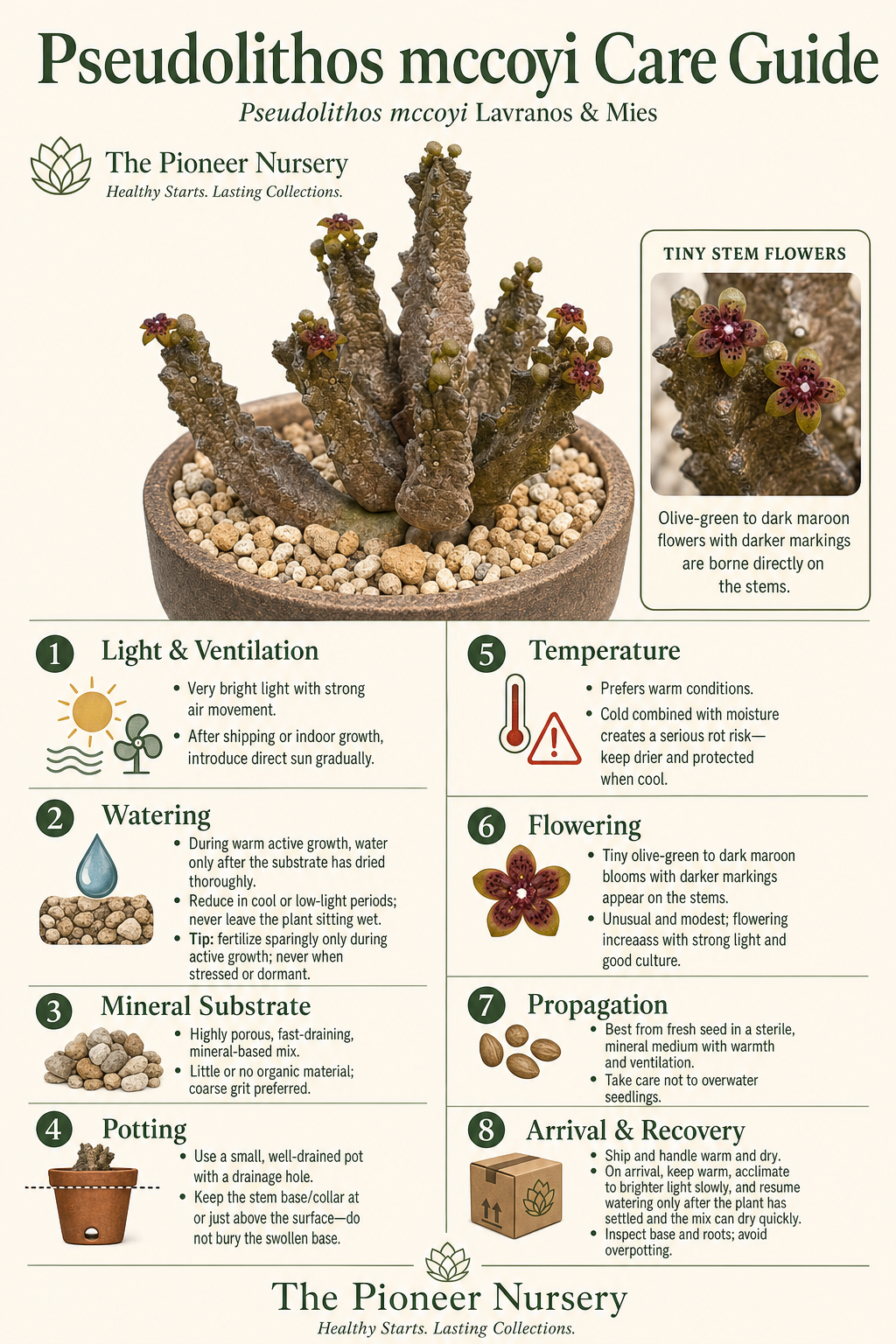
Pseudolithos mccoyi is a small, branching, stone-mimicking succulent subshrub from Oman and Yemen. Its rough, quadrangular stems arise from a swollen base, giving the plant an unusual sculptural appearance. The main care priorities are excellent drainage, strong ventilation, warmth, and careful watering: this species can rot rapidly when cold, wet, poorly aerated, or recently disturbed.
Quick Care Summary
- Provide very bright light with strong ventilation.
- Acclimate gradually to direct sun after shipping or indoor growth.
- Use a highly porous, fast-draining mineral substrate with little or no organic material.
- Water during warm active growth only after the substrate has dried thoroughly.
- Reduce watering in cool or low-light winter conditions.
- Keep the stem base or collar at the substrate surface rather than burying it.
- Keep warm; cold combined with moisture creates a serious rot risk.
- Fertilize sparingly during active growth, never while the plant is stressed or dormant.
About Pseudolithos mccoyi
Pseudolithos mccoyi belongs to Apocynaceae and is native to the southern Arabian Peninsula. It forms rough, quadrangular stems from a swollen base and may branch into a compact, stone-like plant. The species is considered difficult to maintain, especially on its own roots, so conditions and watering should be adjusted for the plant’s root condition, pot size, substrate, airflow, and whether it is grafted.
Light and ventilation
Provide very bright light with strong ventilation. Protect the plant from intense, hot midday sun until it has been gradually acclimated. This is especially important after shipping or when moving a plant from indoor, shaded, or greenhouse conditions. Abrupt exposure to strong direct light can cause sun damage.
Watering
During warm active growth, water only after the substrate has dried thoroughly, then let excess water drain completely. Avoid prolonged wetness, but do not leave the plant severely dehydrated for excessive periods; it may deflate when too dry. Reduce watering during cool or low-light winter conditions. A warm plant that is clearly active may receive occasional light watering, but the substrate should not remain continuously moist. Cold, wet conditions are a major rot risk.
Soil and substrate
Use a very fast-draining, highly porous mineral substrate with little or no organic material. The goal is rapid drainage and good aeration around the roots. A mineral mix is particularly important because Pseudolithos mccoyi is highly susceptible to rot.
Potting and roots
Choose a small, well-drained container and avoid burying the stem base or collar. The swollen base may rest at or near the substrate surface. Under-potting can be useful when it still allows you to control watering effectively. Repot only when necessary, and handle the roots and stem tissue carefully. Rough repotting, damaged tissue, and watering before recovery can lead to root loss or collapse.
Temperature and seasonal growth
Keep Pseudolithos mccoyi warm, preferably above approximately 10°C (50°F). Brief exposure near 5°C (41°F) may be tolerated only when the plant is kept dry; freezing temperatures should be considered unsafe. Growth may slow substantially during cool, short-day winter conditions. Treat winter as a reduced-water period rather than keeping the substrate moist.
Fertilizer
Fertilize sparingly during active growth only, using a diluted fertilizer appropriate for succulents. Do not fertilize stressed, recently shipped, recently repotted, cold, or dormant plants. Direct species-specific fertilizer trials are limited, so conservative feeding is appropriate.
Flowers and pollination
The flowers are very small and have been reported as olive-green to dark maroon with darker markings. They may have an unpleasant carrion-like scent associated with fly pollination in stapeliad relatives. Successful pollination can produce paired seed follicles containing numerous wind-dispersed seeds.
Propagation
Propagation is primarily by seed. Specialist references also report grafting, and grafted plants are common because own-root cultivation can be difficult. Emergency recovery from healthy cuttings may be possible after removing rotted tissue, but cutting propagation should not be considered routine or reliably successful. Grafting is a legitimate horticultural technique, not evidence that either grafted or own-root plants are inherently superior in every situation.
Shipping and arrival care
Receive and ship this species warm and dry whenever possible. Inspect the plant after arrival, particularly if it has traveled bare-root or experienced root disturbance. If roots or stem tissue were damaged, avoid immediate watering; allow damaged areas to dry and provide bright, ventilated conditions before resuming cautious watering. Acclimate gradually to stronger light. These precautions are especially important for own-root plants, but every shipped plant should be assessed according to its condition.
Common Problems
- Rapid basal or stem rot: usually associated with wet substrate, poor aeration, cold conditions, or damaged tissue.
- Deflation and distortion: may result from severe underwatering, though excessive fear of watering can also weaken the plant.
- Sun damage: can follow abrupt exposure to intense direct light after shipping, greenhouse cultivation, or indoor growth.
- Root loss or collapse: may follow rough repotting, poorly drained media, or watering before damaged tissues have healed.
Frequently Asked Questions
How often should I water Pseudolithos mccoyi?
Do not use a fixed calendar. During warm active growth, wait until the substrate has dried thoroughly, then water fully and allow excess water to drain. Water less during cool or low-light conditions.
Does Pseudolithos mccoyi need full sun?
It needs very bright light, but intense hot midday or unacclimated full sun can cause damage. Increase direct light gradually, especially after shipping or indoor growth, and maintain strong ventilation.
What soil is best for this species?
Use a very fast-draining, highly porous mineral substrate with little or no organic material. This helps reduce the prolonged wetness and poor aeration that can trigger rot.
How should I care for a shipped plant?
Keep it warm and provide bright, ventilated conditions. Inspect for root or stem damage, avoid immediate watering when tissues were disturbed, and acclimate gradually to stronger light. Resume cautious watering after damaged tissues have dried.
Can Pseudolithos mccoyi be propagated from cuttings?
Propagation is primarily by seed. Grafting is also reported, while emergency recovery from healthy cuttings may be possible after removing rotted tissue; cutting propagation is not routine or reliably successful.
Pseudolithos mccoyi rewards precise cultivation rather than frequent attention. Warmth, bright acclimated light, excellent airflow, a porous mineral substrate, and a dry-down between waterings are the foundations of successful care. Monitor the plant’s condition and adjust watering to its growth, temperature, light, and root health.