Echinopsis subdenudata ‘Lime’ Care Guide
Learn how to grow Echinopsis subdenudata ‘Lime’, a small globular cactus with woolly areoles and fragrant, night-opening flowers.
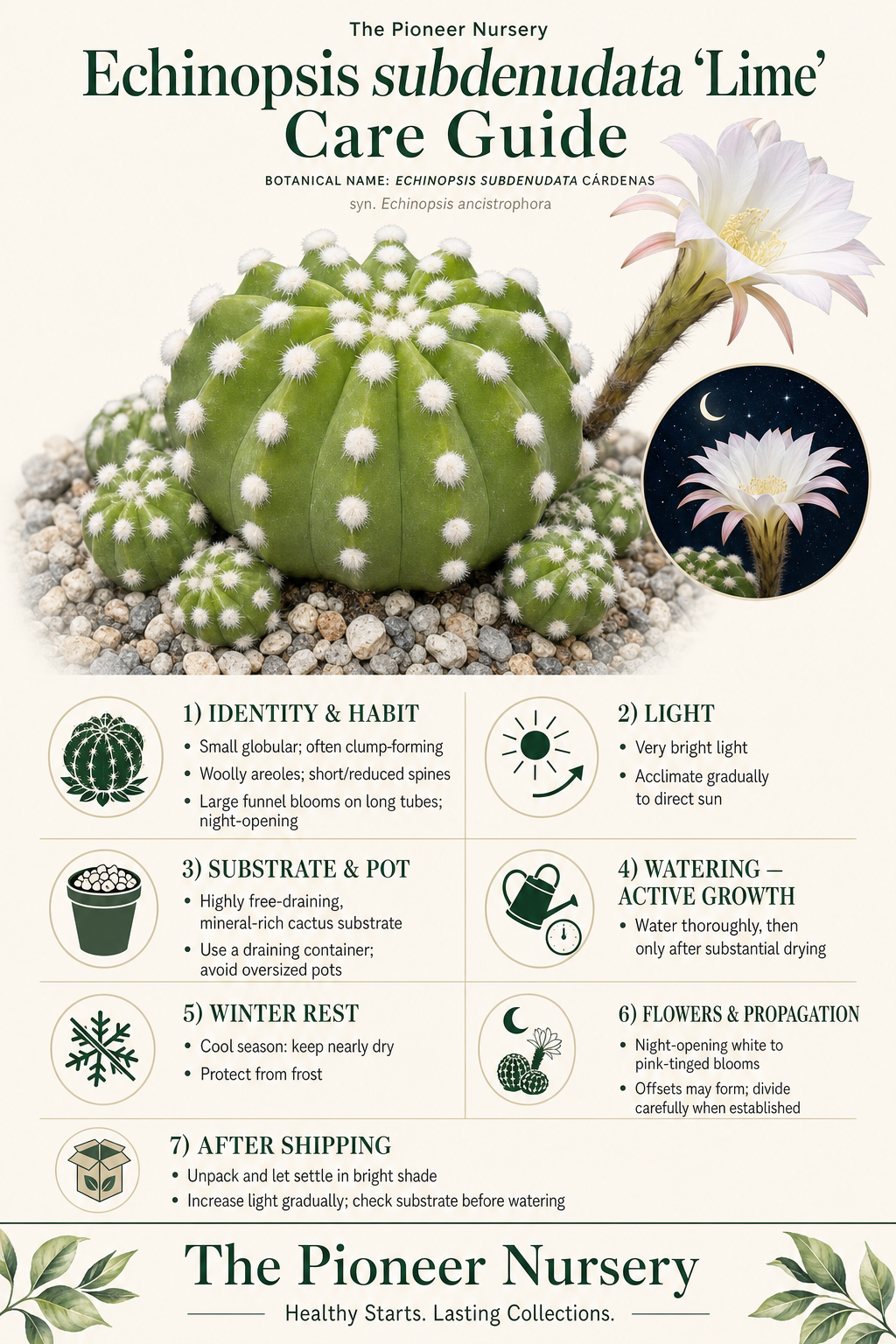
Echinopsis subdenudata ‘Lime’ is a small, often clump-forming globular cactus with woolly areoles and short or reduced spines. Its care centers on bright, gradually acclimated light, fast drainage, thorough watering during active growth, and a cool, nearly dry winter rest.
Quick Care Summary
- Provide very bright light and acclimate gradually to direct sun.
- Use a highly free-draining, mineral-rich cactus substrate.
- Water thoroughly during active growth only after substantial drying.
- Keep nearly dry during a cool winter rest and protect from frost.
- Use a draining container and avoid oversized pots.
Light
Provide very bright light with several hours of gentle direct sun or bright filtered light. Acclimate plants gradually when moving them from shaded nursery conditions into stronger sun. Abrupt exposure to intense midday or south-facing window sun can cause scorch. Insufficient light may result in weak, elongated growth and reduced flowering.
Watering
During active growth, water thoroughly and then allow the substrate to dry substantially before watering again. Reduce watering as growth slows, and keep the plant nearly dry during a cool winter rest. Avoid continuously wet roots, especially when temperatures are low.
Soil and Substrate
Use a very free-draining cactus substrate with substantial mineral content, such as coarse sand, pumice, perlite, grit, or fine gravel combined with a modest organic component. The mix should hold enough moisture for active growth without becoming dense or waterlogged.
Potting and Roots
Choose a container with an ample drainage hole and avoid oversized pots. Repot in spring or at the beginning of active growth when necessary. Remove damaged or rotting roots, allow significant root wounds to dry, and delay watering after major root disturbance while the plant recovers.
Temperature and Winter Rest
Protect the plant from frost. A cool, dry winter period is suitable; RHS guidance gives an approximate frost-free minimum range of 2–7 °C under glass. For conservative household cultivation, keep it above roughly 7–10 °C whenever possible, especially when humidity or substrate moisture is high. Maintain bright conditions, good ventilation, and little to no water during the cooler, darker season. Resume watering gradually as light and temperatures increase.
Fertilizer
During active spring and summer growth, apply a dilute, low-nitrogen cactus fertilizer occasionally to already-moist soil. Do not fertilize during winter dormancy or while the plant is stressed, freshly repotted, or experiencing root problems.
Flowering
Mature plants can produce large white to pink-tinged white, fragrant, funnel-shaped flowers on long tubes. Flowers generally open at night and are reported in spring or early summer. Strong light, adequate summer growth, and a cooler, drier winter rest can support flowering, although young or stressed plants may not bloom.
Propagation
Propagation is possible from seed or by separating rooted offsets. Allow separated offsets or damaged cuttings to callus before planting, and keep propagation material relatively dry until roots begin to form. Seed propagation may be slower but preserves genetic variation, while offsets produce clones of the parent plant.
About the Plant
This cactus is also known as barbed sea urchin cactus, Domino cactus, Easter lily cactus, and night-blooming hedgehog cactus. Plants of the World Online treats Echinopsis subdenudata as a synonym of Echinopsis ancistrophora. “Lime” has not been verified as a formally registered cultivar, so it is retained here as a commercial or collector descriptor.
Common Problems
Root or stem rot can result from dense substrate, poor drainage, or watering while the plant is cold. Sunburn may follow abrupt movement from shade into intense light. Mealybugs may hide around areoles, the root collar, or offsets. Flowering may fail when light is insufficient, the plant is not mature, or it has not received a seasonal rest. Wet exposure to freezing temperatures can cause cold injury.
Shipping and Arrival Care
After arrival, inspect the plant for damage or rot and provide bright but initially filtered light. Acclimate it gradually to direct sun. If it arrived bare-root or recently disturbed, allow damaged roots to dry before watering. Protect shipments from freezing temperatures and prolonged cold, wet packaging.
Frequently Asked Questions
How much light does Echinopsis subdenudata ‘Lime’ need?
Provide very bright light with several hours of gentle direct sun or bright filtered light. Acclimate gradually after shaded conditions to reduce scorch.
When should I water this cactus?
Water thoroughly during active growth after the substrate has dried substantially. Reduce watering as growth slows and keep the plant nearly dry during a cool winter rest.
Can it flower indoors?
Mature plants can flower indoors with strong light, adequate summer growth, and a cooler, drier winter rest. Young or stressed plants may not bloom.
What soil should I use?
Use a very free-draining cactus mix with substantial mineral material such as pumice, perlite, grit, gravel, or coarse sand, plus a modest organic component.
How should I handle a bare-root plant after shipping?
Inspect the roots, allow damaged areas to dry, provide initially filtered bright light, and avoid immediate heavy watering after significant root disturbance.
With bright light, excellent drainage, careful watering, and a cool winter rest, Echinopsis subdenudata ‘Lime’ can remain compact and may reward mature growth with fragrant night-opening flowers.