Lithops aucampiae Care Guide
Learn how to grow Lithops aucampiae, an Aucamp’s living stone, with bright light, mineral soil, seasonal watering, and a dry leaf-replacement period.
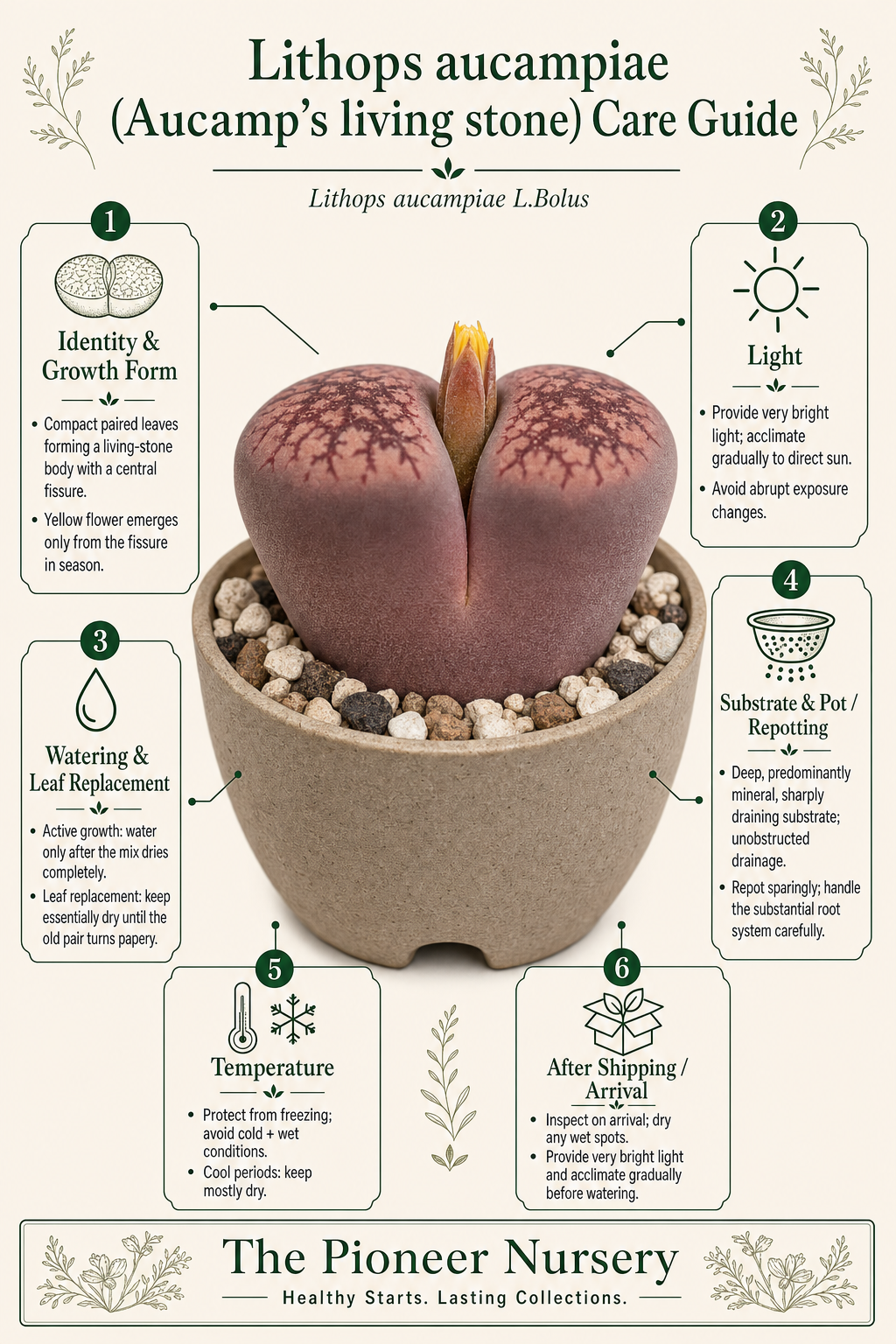
Lithops aucampiae, commonly called Aucamp's living stone, is a small, slow-growing living stone with paired leaves that store water. Successful care depends on its annual cycle: provide very bright light, use a deep mineral substrate that dries quickly, and keep the plant nearly dry during dormancy and leaf replacement. The old leaf pair should gradually become papery and be reabsorbed as new leaves develop.
Quick Care Summary
- Provide very bright light and acclimate gradually after shipping or repotting.
- Use a deep, predominantly mineral substrate with unobstructed drainage.
- Water only during suitable active-growth periods, allowing the mix to dry completely.
- Keep the plant essentially dry during leaf replacement until the old pair becomes papery.
- Protect from freezing and avoid cold, wet conditions.
- Repot sparingly and handle the substantial root system carefully.
About Lithops aucampiae
This species forms a compact pair of fleshy leaves and may remain in the same container for many years. Some shriveling is normal because the leaves store water, so appearance alone does not always indicate a need to water. Strong light, good ventilation, and careful seasonal care matter more than frequent attention.
Light
Provide very bright light with several hours of direct sun. Morning sun or filtered light during the hottest part of the day is preferable. Acclimate gradually after shipping, repotting, or lower-light conditions to prevent sunburn. Stretching, weak growth, and fading coloration can indicate insufficient light. Fresh air is especially helpful in enclosed growing spaces.
Watering and seasonal cycle
Do not water by a fixed calendar; follow the plant's growth stage and how quickly the substrate dries. The sequence below describes a typical Northern Hemisphere pattern, while seasons may differ elsewhere:
– Late spring into summer: watering may resume if the plant is actively growing.
– Summer: reduce or stop watering during the rest period, especially in hot conditions.
– Late summer through autumn: flowering and active growth may begin; watering can resume when conditions support drying.
– Winter and spring: keep the plant essentially dry while the old leaf pair is reabsorbed and replaced.
Allow the mineral substrate to dry completely between active-growth waterings. The old leaves should become dry and papery before regular watering resumes; premature watering increases rot risk.
Soil and substrate
Use a very fast-draining, porous, predominantly mineral mix containing coarse sand, grit, pumice, perlite, or similar materials, with only a modest organic component. The mix should support the roots while preventing prolonged moisture around the plant base. A mineral top dressing may be used if desired.
Potting and roots
Choose a container with an unobstructed drainage hole. Although the plant is small above ground, Lithops develop a substantial root system, so a pot approximately 3–5 inches deep is appropriate for many specimens. Set the body slightly above the surrounding substrate rather than burying it. Repot sparingly. After significant root disturbance, keep the plant dry while damaged roots heal, then reintroduce light and water cautiously.
Temperature and ventilation
Protect Lithops aucampiae from freezing. Warm, well-ventilated conditions suit active growth, while cold temperatures combined with wet substrate create a serious rot concern. In climates subject to frost, cultivate the plant in a sheltered setting, generally under glass or equivalent protection.
Fertilizer
Fertilize sparingly only during active growth, using a dilute, low-nitrogen fertilizer. Do not feed during dormancy, flowering-related stress, or leaf replacement. Excess fertilizer can encourage weak growth and cannot compensate for inadequate light or poor drainage.
Flowering
Flowers emerge from the fissure between the leaves, generally in late summer or autumn and sometimes into early winter. They are typically yellow in this species and open during sunny afternoon conditions. Lithops are generally self-sterile, so producing seed normally requires pollen from a genetically different plant.
Propagation
Propagation is primarily by seed or, when a mature multi-headed plant permits it, by careful division. Sow seed in a well-drained mineral medium with only a thin covering. Keep seedlings lightly and consistently moist during germination, then gradually introduce drying periods. Avoid overwatering because damping-off is a significant risk.
Common problems
– Root or basal rot: usually linked to wet, poorly aerated substrate or watering during dormancy; improve drainage and respect the dry cycle.
– Leaf splitting, abnormal new growth, or failed replacement: may follow premature or excessive watering; review the plant's growth stage.
– Sunburn: follows abrupt exposure to intense light; acclimate gradually.
– Stretching, fading coloration, or weak growth: can indicate inadequate light.
– Pests: monitor for aphids and mealybugs, as well as possible scale, thrips, spider mites, snails, slugs, and root-knot nematodes.
Shipping and arrival care
Inspect the plant after arrival and protect it from freezing and prolonged cold, wet conditions. Start with bright but moderated light, then increase direct exposure gradually. If it arrives bare-root or with substantial root disturbance, pot it into a dry, well-drained mineral mix and delay watering until damaged roots have recovered. Arrival alone is not a reason to water.
Frequently Asked Questions
How can I tell whether shriveling is normal?
Lithops store water in their paired leaves, and the old pair naturally shrivels as it is reabsorbed. Check the growth stage and substrate condition rather than watering based on shriveling alone.
Should I water by season or by a schedule?
Use the seasonal cycle as a guide, not a fixed calendar. Water only during active growth when the substrate can dry completely, and keep the plant essentially dry during leaf replacement.
What should I do if my plant arrives bare-root?
Pot it into a dry, fast-draining mineral mix, protect it from cold and wet conditions, and delay watering until disturbed roots have had time to recover. Begin with bright but moderated light.
Why is my Lithops becoming stretched or losing color?
Stretching, weak growth, or fading coloration can indicate inadequate light. Increase light carefully, since abrupt exposure to intense sun can cause sunburn.
Can I grow Lithops aucampiae from seed?
Yes. Use a well-drained mineral medium with only a thin covering, keep seedlings lightly and consistently moist during germination, and then gradually introduce drying periods. Overwatering increases damping-off risk.
Lithops aucampiae rewards growers who follow its seasonal rhythm rather than watering by habit. Strong light, rapid drainage, careful observation, and a genuinely dry leaf-replacement period are the foundations of long-term health.